What a Cardiac Stress Test Can Tell You About Your Heart
- Category: Heart Care, Heart and Vascular Center
- Posted On:
- Written By: Brandon Egner, Valley View Heart & Vascular Center
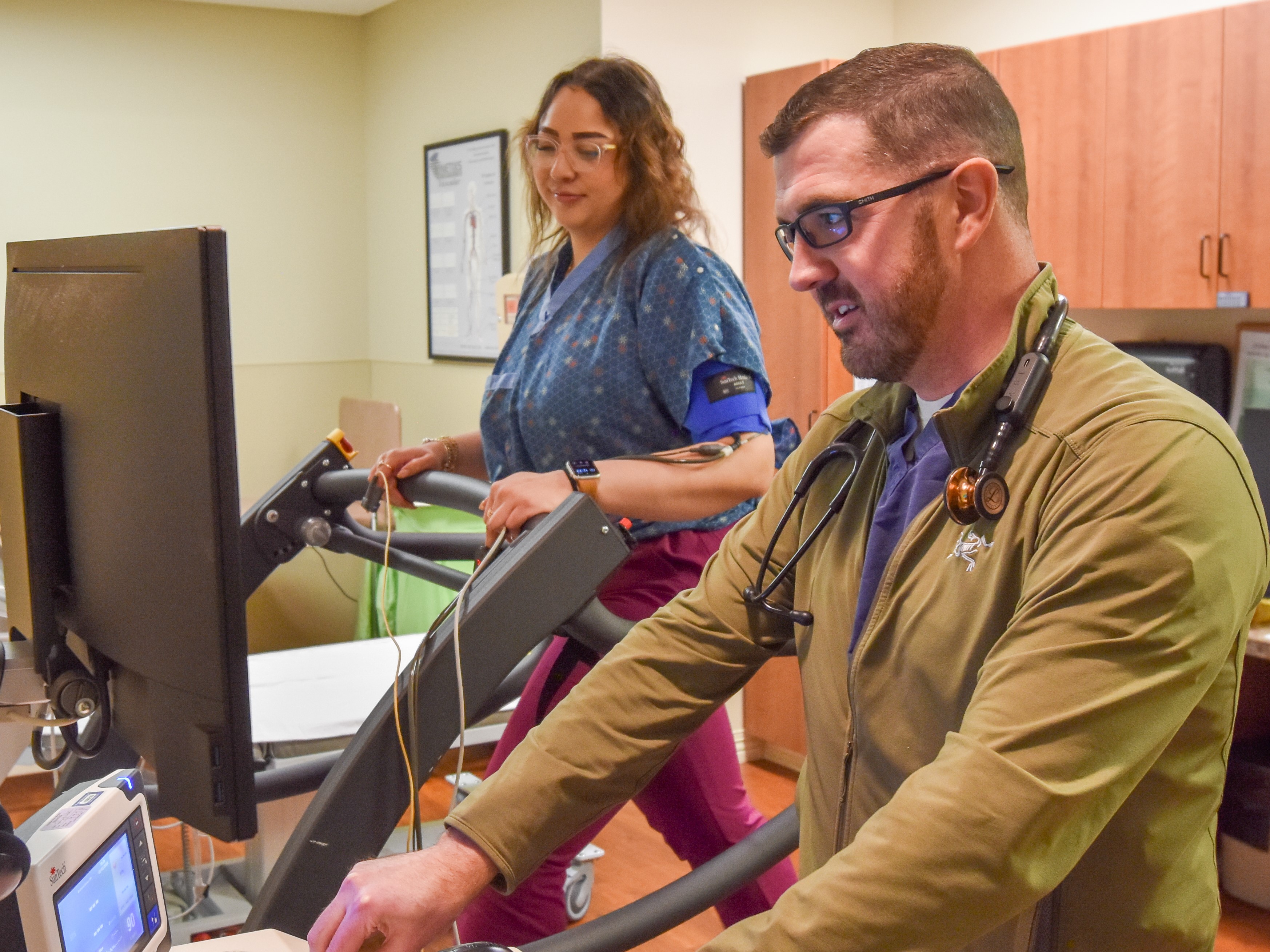
Heart disease remains the leading cause of death worldwide and it touches nearly every person directly or indirectly. Some quick, eye-opening facts about heart disease in the United States, per the CDC:
- Heart disease is the leading cause of death for men, women and people of most racial and ethnic groups.
- One person dies every 34 seconds from cardiovascular disease.
- In 2023, 919,032 people died from cardiovascular disease – the equivalent of 1 in every 3 deaths.
- Heart disease costs about $420 billion from 2020 to 2021 alone.
A vast majority of these deaths are completely preventable, which is why early detection and prevention are so important. One of the most powerful tools we have to evaluate cardiovascular health is cardiac stress testing: a safe, non-invasive set of diagnostic testing tools that could potentially save you or a loved one’s life.
What is cardiac stress testing?
A stress test helps us understand how well – or poorly – your heart responds to stress, either by performed exercise or by using certain drugs that mimic the effects of exercise. It can help identify blockages within the coronary arteries (small blood vessels that supply the heart’s muscle with blood), or a potentially serious underlying structural abnormality, such as a faulty heart valve.
During the test and depending on the type performed, we monitor stress-induced symptoms, electrical strain changes via continuous electrocardiogram (ECG) monitoring, blood pressure and oxygenation, functional/exercise capacity and imaging of the heart via ultrasonography or nuclear imaging.
Who benefits from a stress test?
Those who might benefit from a stress test not only include individuals who are experiencing classic cardiac symptoms, such as exertional chest discomfort/pressure, shortness of breath, unexplained fatigue, palpitations or irregular heartbeats, but also those who have a family history of premature heart disease, especially in first-degree relatives. They are also routinely performed on individuals undergoing non-cardiac surgeries if they have additional risk factors, including diabetes, hypertension, hyperlipidemia, or an abnormal baseline ECG that warrants further investigation.
Types of stress tests
The type of test ordered depends on multiple factors, including symptoms, prior cardiac history, baseline ECG findings, pretest probability of having an underlying abnormality and physical ability to exercise or not.
Below is a list of stress testing modalities currently offered and performed at the Valley View Heart & Vascular Center.
- Exercise stress ECG (treadmill or bike): This is the preferred initial test generally reserved for younger, healthy patients who can exercise and have a normal, interpretable ECG. It provides information on exercise capacity, symptoms and ECG changes, but has lower sensitivity and specificity compared to imaging-based tests. It is not suitable for patients with certain baseline ECG abnormalities or those unable to exercise adequately.
- Stress echocardiography: Uses either exercise or pharmacologic agents to induce stress, with ultrasound imaging of the heart to assess for abnormalities. This test offers high specificity, no radiation and additional information on valvular and ventricular function.
- Nuclear stress test: Involves exercise or pharmacologic/chemical stress. A radiotracer injection is given to assess how well blood is perfusing the arteries of the heart.
- Coronary CT angiography with FFR (with or without calcium scoring): Unlike the other tests mentioned, this requires no exercise or stress. It only requires lying in a CT scanner for a few minutes but does require contrast. It provides highly detailed, direct imaging of the heart and coronary arteries. If arterial blockages are identified, it can measure how significant/severe the blockages are with high accuracy.
In the event of an abnormal test, further diagnostic testing may be recommended. This may include a heart catheterization, a minimally invasive procedure that involves accessing the coronary arteries via a tiny catheter tube to directly assess the arteries. In most cases, if a significant blockage is identified, it can usually be intervened upon by expanding a tiny balloon to reopen the artery followed by placement of a mesh stent.
Cardiac stress testing is a safe, effective way to catch heart problems early—before they become emergencies. Whether you’re experiencing symptoms or just want peace of mind, talk to your provider about whether a stress test is right for you.
At the Valley View Heart & Vascular Center, we work closely with your primary care provider to get you in quickly. Once you’re referred, we take a full history and physical exam and then choose the right test based on your symptoms and risks.
For more information, call the Valley View Heart & Vascular Center at 970.384.7290.